No probes. No wires. No shutdown. Your iPhone can hear the harmonics.
Anchored on the 60 Hz hum, tracking the 2nd to 7th harmonics.
Scan it from across the room, or set it on the housing and let go — the sensor knows when you're on it.
HumHarmonics listens to the steady hum a transformer or reactor makes, isolates the 60 Hz fundamental and its harmonics, and turns them into a clear distortion reading, right on your phone.
Hold the bottom corner of your iPhone toward the transformer or reactor, near the center of the housing where the hum is strongest.
HumHarmonics locks onto the 60 Hz fundamental and measures the 2nd to 7th harmonics in real time, with the raw, flat microphone response the app forces on.
Get Total Harmonic Distortion, per-harmonic ratios, and a plain NORMAL · WARNING · CRITICAL status, capture it and compare the unit against its own baseline next round.
One app that adapts to how close you can safely get — survey from across the room, or press in for the sharpest read.
Point your iPhone at the transformer or reactor and HumHarmonics listens continuously, locking onto the hum's harmonics in real time. Ideal for a fast survey, enclosed or hard-to-reach units, or simply keeping your distance. Capture any moment with a tap.
Rest the bottom corner of your iPhone on the housing. The motion sensor feels the contact, starts a high-quality reading on its own, and stops the instant you lift away — your steadiest, most repeatable measurement, hands-free from touch to lift.
Checking a transformer or reactor usually means clamps, meters, or a scheduled outage. HumHarmonics works from the sound the core and windings make while the unit stays energized — scan it from a step back, or rest the phone's corner on the housing for the sharpest read. Either way the panel stays shut, no conductor is probed, and your hands stay off the electrical side.
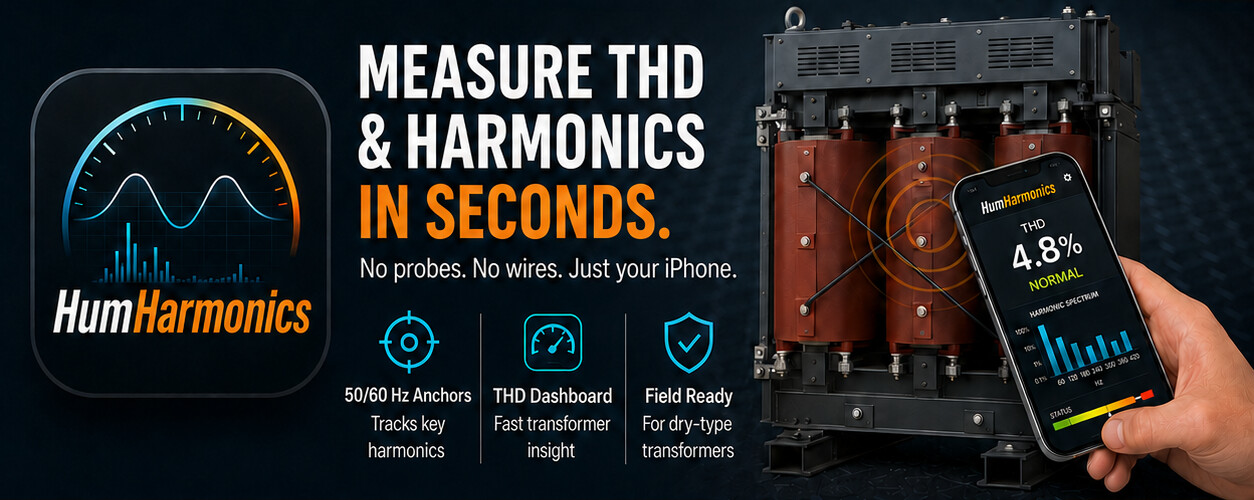
HumHarmonics shows the numbers that matter for transformer health, without a cart of test gear or a shutdown window.
The exact percentage matters less than which way it's heading. Baseline a healthy unit, repeat the reading the same way on your rounds, and a figure that climbs from where that unit used to sit is your early warning, often long before anything else shows it. The color bands are a quick guide; the trend is the real story.
Distortion sits in a healthy range. Log it as this unit's baseline and move on.
Elevated, or climbing from this unit's baseline. Worth a closer look and a tighter re-check interval.
High, or a sharp jump from baseline. Flag the unit for inspection and prioritize it against the rest of your fleet.
These bands are estimated example values, shown for illustration and not tested or calibrated for your device; what matters most is how a single unit's reading moves over time.
No clamp meters, no probes, no exposed conductors, no outage. Just your iPhone and the hum.
Anchors on the 60 Hz fundamental and pulls out the 2nd through 7th harmonics by exact frequency.
One distortion figure with a green / amber / red status, so the answer is obvious in the field.
A real-time bar graph of the fundamental against its harmonics helps you see the harmonic landscape.
Save timestamped readings so each transformer or reactor builds its own history, and a rising distortion trend stands out at a glance.
One less instrument on the truck. If you have your iPhone, you have a harmonic analyzer.
Any line-fed transformer — or reactor — running on a steady 60 Hz supply produces a hum rich in harmonics. HumHarmonics is happiest on dry-type transformers and open reactors you can safely get a phone close to.
The core focus, open, ventilated, and easy to get a reading near.
Input line reactors on variable-frequency drives, where taming harmonics is the whole point.
Filter, load, and output reactors, check the choke is doing its job.
Step-down transformers in electrical rooms and mechanical spaces.
Distribution transformers feeding process equipment and MCCs.
Water, wastewater, and facility transformers on routine rounds.
Isolation and PDU transformers where harmonics matter most.
Solar and inverter-adjacent transformers on the AC side.
Where you can safely approach the enclosure from outside.
From a safe, permitted distance, a quick harmonic sanity check.
Safety first, always. HumHarmonics is a measurement aid, not a reason to enter an energized space. Take a reading only from where you are trained and permitted to stand, and follow your site's electrical-safety rules. It reads best on line-fed, constant-frequency transformers and reactors; oil-filled and heavily enclosed units may muffle the hum.
Popular with electricians, plant and facility maintenance, and municipal water & wastewater teams, useful anywhere a transformer or a drive's line reactor needs a quick harmonic check.
HumHarmonics is launching on the App Store. Leave your email and we'll tell you the day it's live.